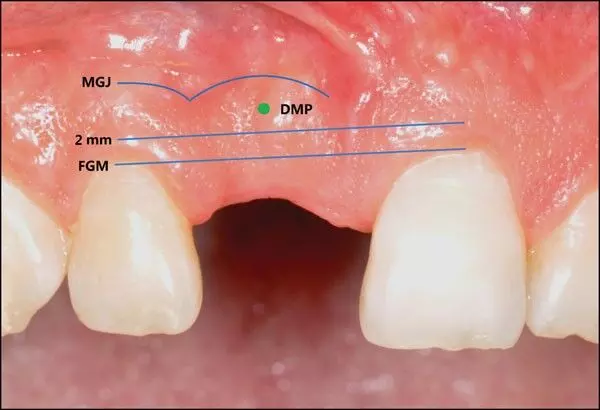
Researchers have found in a new research that using an internally beveled vestibular incision combined with multilayer suturing helps preserve peri-implant papillary integrity. This approach promotes predictable primary intention healing following reconstructive peri-implantitis surgery and is particularly beneficial in esthetically sensitive areas.As the outcome of reconstructive peri-implantitis surgery is highly dependent on complication-free healing with focus on primary intention healing, clinicians should take into account that the wound healing capacity at peri-implant sites is compromised due to fundamental structural biological differences when compared to periodontal tissues. In this context, tunneling flap techniques that avoid superficial incisions in the interproximal soft tissues, specifically between adjacent implants, where the papillary region constitutes a critical weak point, can be a key strategy. When employed together with vestibular access flaps, precise multilayer closure techniques may be applied to stabilize the wound within the highly movable alveolar mucosa and in this way improve predictable primary wound healing.An internally beveled vestibular incision in the alveolar mucosa is introduced and described in this article. After flap preparation and implant surface decontamination, defects were reconstructed using autogenous tuberosity bone. Executing the initial bevel from coronal to apical (internal) created an additional tissue wedge that was incorporated into the coronal flap margin, increasing its surface area and facilitating closure in four distinct layers. The modified approach resulted in primary wound healing in these cases and was associated with substantial reconstructive outcomes at 1 year. Preserving peri-implant papillary integrity by an internally beveled vestibular incision together with multilayer suturing may be beneficial to attain predictable healing by primary intention after reconstructive peri-implantitis surgery, which is also relevant in esthetic areas.Reference:E. Gülnergiz, S. M. Abraha, M. Hürzeler, and O. Zuhr, “ Reconstructive Peri-Implantitis Surgery Using an Internally Beveled Vestibular Incision for Multilayer Wound Closure,” Journal of Esthetic and Restorative Dentistry (2026): 1–10, https://doi.org/10.1111/jerd.70124.Keywords:Study, details, technique, Preserve, Peri-Implant, Papilla, After, Reconstructive Surgery, E. Gülnergiz, S. M. Abraha, M. Hürzeler, and O. Zuhr
Study details technique to Preserve Peri-Implant Papilla After Reconstructive Surgery
 By
health_news
By
health_news