
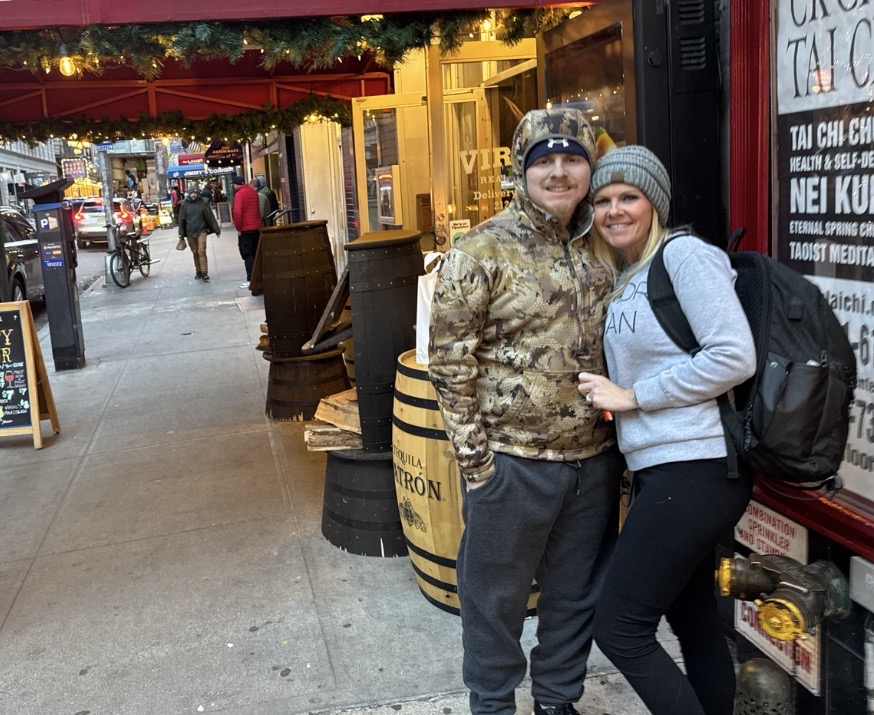
Mason Henderson with his mother, Tabitha Lowe, in November during a visit to New York, where Henderson was participating in a clinical trial to treat his brain cancer. Henderson died in May after a two-year battle with the disease. (Jerry Lowe)
Eighteen months after his initial diagnosis, chemotherapy hadn’t slowed 21-year-old Mason Henderson’s rare brain tumor, which had spread to his spinal fluid. So he left his home in southeastern Texas to spend three weeks in a clinical trial in New York City.
But that failed, too, leaving a murky path for Henderson, whose cancer was so rare the World Health Organization had only given it a name in 2021. So early this year, Henderson’s doctors, evaluating his tumor’s deep genetic language, turned to a drug made by Merck and AstraZeneca called Lynparza.
It was not the standard of care for Henderson’s condition — there wasn’t really any standard, which is not unusual for rare cancers. And Henderson’s insurance would not pay for it, despite the careful justification given by the two specialists treating him.
“They have no guidelines for his cancer,” Henderson’s mother, Tabitha Lowe, said in a March interview with KFF Health News. “They’re discriminating against him because his cancer is so rare.”
Tabitha Lowe and her son Mason Henderson. Lowe spent six weeks trying to get an $8,700-a-month drug for her son that the family’s pharmacy benefit manager wouldn’t cover. (Tabitha Lowe)
Every year, tens of thousands of people — representing about a quarter of all U.S. cancers — are diagnosed with tumors that differ enough from frequently identified ones to be called rare. In determining whether to reimburse treatment for such ailments, insurers turn to Food and Drug Administration labels and expert guidelines.
But these rare afflictions often lack targeted, FDA-approved treatment options, even though in many cases, molecular tests offered by diagnostic companies and university labs can provide a strong suggestion of what will work.
“Insurance coverage routinely trails behind what genomic testing reveals about a patient’s cancer and what the science supports,” said Olivier Elemento, director of Weill Cornell Medicine’s Englander Institute for Precision Medicine.
Henderson’s neuro-oncologists, Jacob Mandel of the Baylor College of Medicine and Jessica Schulte of NYU Langone Health, decided to try Lynparza, also known by the generic name olaparib, in combination with chemotherapy. There wasn’t a wealth of evidence behind the drug but there was a “biologically reasonable” assumption it would help, Schulte said, because cells in tumors like Henderson’s have a flaw that drugs like Lynparza can target. Providers in several previous cases had seen brain cancers like Henderson’s respond well to the drug.
“In general, we try to base our treatment decisions on large patient studies” involving hundreds of patients, Schulte said. But large clinical trials will probably never be conducted for a cancer as rare as Henderson’s.
Schulte, who specializes in brain cancers in young adults, sees only a few of Henderson’s type each year, she said.
Mandel prescribed the drug on Jan. 16. Liviniti, Henderson’s pharmacy benefit manager, responded with a quick refusal on Jan. 30. Two weeks later, the company sent an explanation: “Lynparza is not approved for the diagnosis provided.” Out-of-pocket, the drug would cost about $8,700 per month, Lowe said. Liviniti did not respond to phone calls seeking comment.
Before his diagnosis, Henderson was a healthy, athletic young man with a big heart, faith in Jesus, and a tight group of friends, his mother said. At Evadale High School, north of Beaumont, Texas, Henderson played baseball and football and was homecoming king in 2022. After graduating, he worked at the local paper mill, spending his free time hunting, fishing, and exploring the woods on an all-terrain vehicle. He wanted to be a police officer, Lowe said.
Henderson was 20 on March 15, 2024, when his brother Gunner found him at the top of the stairs in the family home with his head in his hands. “He was in the post-seizure state,” Lowe said. “He couldn’t talk. Was crying. Trying to hug me. Could not communicate.”
At an emergency room in Beaumont, an MRI revealed a large tumor. He was transferred to Baylor St. Luke’s Medical Center in Houston and diagnosed with a form of brain cancer called diffuse hemispheric glioma (H3-G34 mutant).
Surgery a few days later cut out 90% of the tumor, but brain cancers are almost impossible to remove entirely, because of the delicacy of the tissue they’re embedded in, Schulte said.
After 16 months of radiation and chemotherapy, a September 2025 scan showed the cancer had spread to his spinal cord, a condition called leptomeningeal disease that usually proves fatal within a few months. Mandel contacted Schulte about a clinical trial she was leading. It consisted of 11 days of brutal craniospinal irradiation, which left Henderson exhausted. When it was over, the cancer was still there.
“The family was wonderful,” Schulte recalled. “They were trusting in their team, but they asked appropriate questions to make sure that we were thinking about Mason as a person.”
Coverage Refused
Lynparza, approved by the FDA in 2014 for ovarian cancer, works by interfering with tumor cells’ ability to multiply. After Liviniti, the pharmacy benefit manager, refused coverage for Henderson, his family turned to Jefferson County. Henderson’s stepfather, Jerry Lowe, flies helicopters for the county sheriff’s office.
The county, which had the final say on reimbursement because it pays claims directly for its employees’ family health coverage, also refused. When Henderson’s family appealed, the county review board authorized an independent medical reviewer to look at the case. The nonspecialist supported the board’s finding and recommended another drug, but Henderson’s doctors disagreed. The board didn’t respond to a request for comment.
AstraZeneca had also turned down the family’s request for a donation of the drug. By then it was March, six weeks after Lynparza was prescribed.
Cancers that start in the brain are unusual — only about 25,000 cases are diagnosed in the U.S. each year, compared with 320,000 breast cancers and 229,000 lung cancers. Only a few hundred people each year, mostly young adults, are diagnosed with Henderson’s type, according to Schulte.
Treatment options for diffuse hemispheric glioma are few; brain cancers in general are often excluded from clinical trials. They represent a relatively small market for a pharmaceutical company. Testing drugs against them is risky, because of the brain’s sensitivity, and difficult because the drug must pass through the tightly packed cell walls lining the blood vessels, known as the blood-brain barrier.
Patients like Henderson often struggle to get medications that are prescribed off-label based on recent scientific findings. (Tabitha Lowe)
Still, drugmakers are increasingly homing in on narrower and potentially more accurate drug targets as science reveals more of cancer’s remarkable molecular diversity.
Under guidance issued in 2022, the FDA has approved nine drugs to be used for patients whose tumors have specific mutations, regardless of the organ where the cancer first appeared. These “tissue agnostic” drugs are still a tiny minority, but as genome sequencing becomes more common — growing numbers of oncologists order it for patients — insurers will have to keep up, Weill Cornell’s Elemento said.
Several U.S. research groups are hosting clinical experiments known as “basket trials,” in which mostly late-stage cancer patients are put on drug combinations based on tumor genetics, rather than the organ of origin.
The American Society of Clinical Oncology has recruited more than 3,000 patients into one of the biggest efforts, the Targeting Agent and Profiling Utilization Registry, or TAPUR, which began in 2016. It provides off-label treatments at no cost to advanced-staged cancer patients at more than 270 U.S. oncology practices.
About half the participants have benefited, and in rare cases the treatment kept patients alive for a year or more or seemingly cured them, said Richard Schilsky, the program’s founder and its principal investigator until recently. The results have led to changes in several treatment guidelines, he said, and a change in guidelines “usually is sufficient to create a pathway to reimbursement by insurance.”
Research has uncovered “quite a few” cases in which Lynparza was effective against a variety of tumor types, Schilsky said. But like many clinical trials, TAPUR excludes patients with primary brain tumors — like Henderson’s.
Oncologists disagree on how broadly genetics discoveries will transform cancer diagnosis. Cancers are currently identified as breast, colon, lung, etc., because those are the cells that pathologists see when diagnosing a tumor, said Razelle Kurzrock, the associate director of clinical research at the Medical College of Wisconsin Cancer Center.
But that’s a “mistake of history,” she said. “You’re making the diagnosis based on the pathologist’s view of the surface of the cell rather than what’s actually driving the cancer.”
A Dutch father and son invented the first light microscope to peer at cells around 1590. The Human Genome Project finished in 2003. If genome-enabled next-generation sequencing, now used for molecular tumor scans, had come before the light microscope, “no one would look at organ of origin,” she said.
Kurzrock leads I-PREDICT, a clinical trial in which every patient gets individualized cancer therapy based on DNA, RNA, and protein patterns in their tumor. Instead of getting drug combination A or B, “in our trial everyone gets a different set of drugs,” she said. Physicians can instead use standard therapies, she said, and their patients are the study controls.
Other oncologists see limitations to purely genetic diagnosis. Certain cancer centers advertise by saying, “‘We’ll sequence your tumor better than anyone else, and therefore you’ll live longer and do better if you come here,’” said Kathy Miller, a professor of oncology at Indiana University. “But the evidence doesn’t support those claims right now.”
‘I Wouldn’t Give Up’
In Henderson’s case, the problem was never diagnosis; Baylor clinicians identified his cancer type quickly. But its rarity and location made the tumor hard to fight, and the lack of financial help made it even harder.
On March 8, Tabitha Lowe went on Facebook, LinkedIn, and Instagram with photos of her son and descriptions of his plight. She tagged AstraZeneca, Liviniti, and the county board that had denied his reimbursement. “Rare cancer patients are denied treatment simply because their cancers are rare,” she wrote in one of the posts, which were shared hundreds of times.
“I hated to take this route, but when it comes to my kids there’s nothing I won’t do,” she told KFF Health News. “I’ve cried, I’ve stressed out, but I wouldn’t give up.”
Tabitha Lowe took to Facebook to try to get her son Mason Henderson access to the brain cancer treatment his doctors sought for him. (Tabitha Lowe)
The next day, AstraZeneca’s patient assistance program, which had turned down her request for the drug two weeks earlier, emailed her with good news: A bottle of 60 Lynparza pills had been shipped to her pharmacy. Company spokesperson Tara Parsell said patient confidentiality prevented her from commenting on its actions.
Lowe’s six-week battle had paid off. Now, “it’s in God’s hands,” she said in an April interview. By mid-April, however, Henderson could no longer walk. Then came issues with his speech. “It all happened so fast.”
On May 4, in the family’s living room, where his bed had been moved, Henderson died, after taking the drug for nearly two months. Hundreds attended his memorial service; their cars made a procession seven minutes long.
The family has created a college scholarship in Henderson’s name for graduates of the local high school. An online campaign and bass fishing tournament had raised nearly $24,000 by September. Willie Robertson of Duck Dynasty, professional pickleballer Tyson McGuffin, and pro fisherman Hank Parker donated items for a raffle. Country singer Mark Chestnutt sent two signed guitars, Lowe said.
“Faster treatment would have been better,” although it’s hard to know whether it would have extended Henderson’s life, NYU’s Schulte said.
“I will always wonder,” Lowe said in a phone interview this summer. “Cancer don’t pause while the paperwork’s in progress.”
“There’s something especially painful thinking about how much time I spent fighting healthcare instead of being with Mason,” she added. “I was forced to become a PBM, insurer, research expert, all while trying to be his mother.”
KFF Health News is a national newsroom that produces in-depth journalism about health issues and is one of the core operating programs at KFF—an independent source of health policy research, polling, and journalism. Learn more about KFF.This article first appeared on KFF Health News and is republished here under a Creative Commons Attribution-NonCommercial-NoDerivatives 4.0 International License.