
Trust has been eroding between U.S. health citizens and the key stakeholder touchpoints that are meant to serve patients in America — whether health insurance plans, hospitals, providers, pharma and med-tech companies, and increasingly technology purveyors such as EHR platforms (most prominently, Epic) and AI for self-care information support.
Some of the trust-eroding factors underpinning Americans’ growing sense of healthcare grievance are increased denials via prior authorization processes, cuts in health care access (such as Medicaid cuts, discussed in this POLITICO analysis), and increasing out-of-pocket spending coupled with low and unsatisfactory levels of expected customer service and lack of personalization and empathy (see Qualtrics on this phenomenon).
It’s the double-barreled issues of spending and care access that’s really gotten into U.S. voters’ hearts and heads in advance of the 2026 mid-term elections.
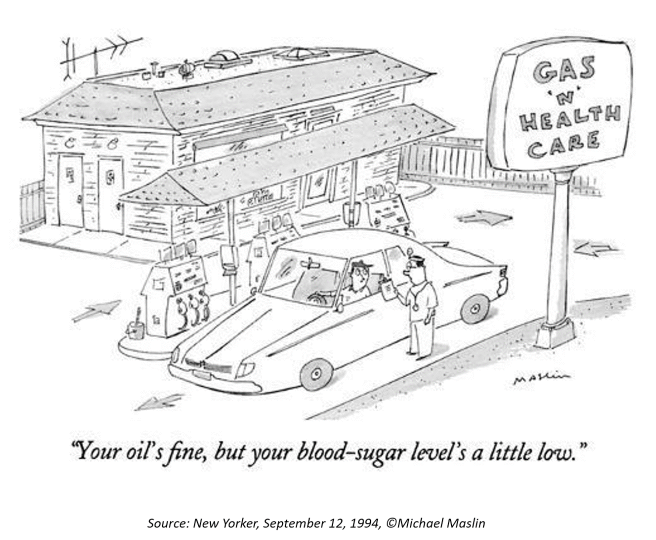
I began to embed this cartoon in my health care consulting client meetings since writing my first blog post here in Health Populi in September 2007. The title of that post was, “Health Care is the #1 Line Item in Our National Economy…and Taking More Out of Our Pockets.”
When Michael Maslin conceived this New Yorker cartoon in 1994, the U.S. allocated 13.7% of the nation’s GDP to health care — about $949 billion.
But the cartoon was timely 32 years ago, and even more relevant in 2026, as the U.S. spend on health care is nearly $6 trillion comprising nearly 19% of the nation’s economy.
s
It’s déjà vu all over again, as the Kaiser Family Foundation (KFF) Health Tracking Poll conducted in late September 2026 (published October 6) found that most Americans just a few weeks before the midterm elections are worried about their ability to afford health care, gasoline (and transportation costs), food and groceries, and utilities (largely driven by the price of oil and energy).
“It’s affordability, stupid,” if we want to sum up where U.S. health citizens are as they engage more in civic society appearing more motivated to vote in the coming election than in the previous one — more likely Democrats’ enthusiasm versus Republicans’ lower levels of voting inspiration.
Overall, nearly one-half of Americans are keener to voter this midterm election. The KFF Poll concurs with the Pew Research Group finding that Democrats appear to be more motivated to vote this time around compared with Independent and Republican voters. Nearly 2 in 3 Democrats feel more motivated to voter versus roughly 3 in 5 Independents and Republicans, the bar chart illustrates. ‘
It’s Democrats who more U.S. voters trust to deal with the cost of health care, the KFF Poll learned, as well as Dems having an edge on handling peoples’ cost of living.
Note that “health care” in the KFF Poll includes the cost of health insurance along with consumers’ out-of-pocket spending for office visits and prescription drugs.
Health Populi’s Hot Points: “The U.S. Health Economy Is a Tragedy of the Commons,” Trilliant Health introduced its recent annual report on the trends shaping American health care.
We can track the earliest origins of the theory of the Tragedy of the Commons back to Aristotle, who in Politics wrote,
“That which is common to the greatest number has the least care bestowed upon it. Every one thinks chiefly of his own, hardly at all of the common interest; and only when he is himself concerned as an individual.”
As Trilliant sees health care in 2026, the Tragedy of the Commons for American healthcare is the lack of system-ness, population un-wellness, market failure, inconsistent value, fraud/waste/abuse, and the negative-sum game that industry stakeholders play: think health insurance, hospitals, providers, pharma — the major cost line-items in U.S. medical care.
“The question for every American,” Trilliant poses, “is whether the commons that is the U.S. health economy is past the point of recovery.”
As the KFF Tracking Poll leading up to the 2026 midterm elections points out, 85% of U.S. voters say major changes in health care are needed — with over 1 in 3 believing the system needs to be completely overhauled.
With affordability driving people to vote on the basis of health care, gas and transportation, food and groceries, utilities and housing, the prospect of a national health plan looms more rational than it has since the advent of Medicare and the Great Society of LBJ.
The post Gas ‘N Healthcare ‘N Voting in November 2026: A Last Pre-Midterms Snapshot on Health Politics on Main Street USA appeared first on HealthPopuli.com.