
The U.S. kitchen table has been host to American consumers’ challenging budgets for the persistently higher costs of food at the grocery store, petrol at the gas station pump, interest rates for houses and expensive durable goods like cars, and healthcare. U.S. adults’ ability to afford healthcare was at a five-year low, a Gallup-West Health poll alerted earlier this year in June. [The methodology calculated that only one-half of Americans felt “cost secure” for healthcare].
TIME magazine, writing from a mass/popular media point of view, wrote that, “Health care costs are becoming unsustainable.”
Providing evidence for TIME‘s assertion, several reports published this month focus us on the evidence-base for growing health insurance costs and how much medical cost-sharing is impacting U.S. consumers and their families. We learn from the annual Kaiser Family Foundation (KFF) Employer Health Benefits for 2026, The Commonwealth Fund’s report on The State of Health Insurance Coverage in 2026, and The 2026 People’s Health Care Survey from the United States of Care.
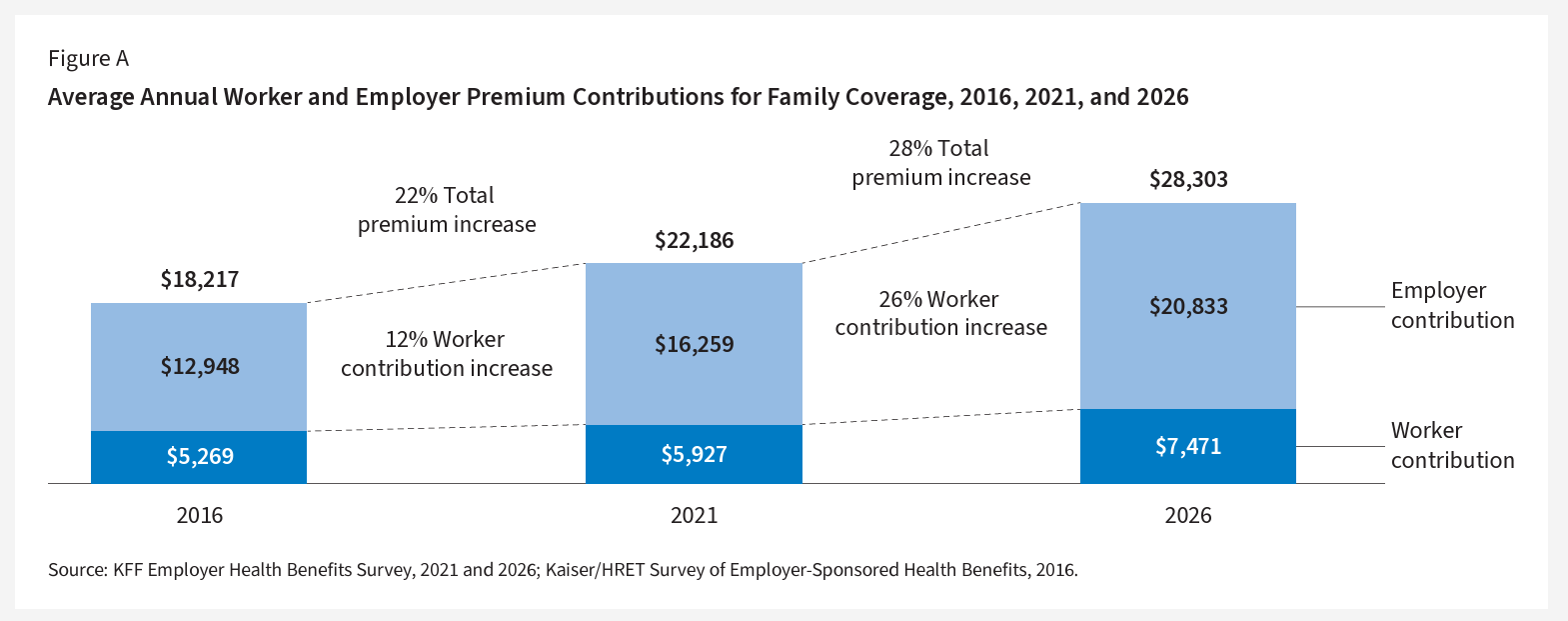
Top-line, employers’ premium costs topped $28,000 to cover a family in 2026, KFF reported. About two-thirds of this premium were covered by companies, and about one-third (nearly $7,500) were attributed to worker contributions for their families’ health insurance.
See in the first chart that the worker contribution increased by 26% from 2021.
This second chart attests to that employer response to the growth of health plan costs, with the intent to increase the share of premium that employees contribute. 44% of companies sponsoring health insurance planned to do so.
In addition, one-fifth of companies would also increase deductibles or cost-sharing for most services.
As insured Americans take on more health care financial burden, the question of affordability is compounded by a higher-cost consumer goods environment and flattening wages: the line chart, Figure B from KFF’s report, clearly illustrates the gap or “bite” between the cost increases for family premiums and workers’ earnings in 2026.
The Commonwealth Fund’s read on the state of health insurance in the U.S. calls out what consumers said was the most important problem in U.S. health care: not finding a doctor or getting an appointment, and not so much prior authorization (which together are 2 factors that contribute to access challenges).
It’s the cost of premiums for health insurance and then the cost of what the health plan member pays for care and prescriptions that together 78% of Americans say are the biggest problems in American health care in 2026 to be improved.
Significantly, these two cost problems were cited fairly equally by Republicans, Democrats, and Independents in the U.S., the Commonwealth Fund illustrated in this bar chart. There would be few other issues with which the three partisans in America would concur in this moment of political schism and separation.
Health Populi’s Hot Points: US of Care’s People’s Health Care Survey revealed that 3 in 4 Americans said health care would be a top 3 voting issue for them; that they support a stronger role for government to make care affordable and available; and, that they feel frustrated, overwhelmed, or helpless about health care costs.
Nearly one-half of U.S. consumers also told US of Care that people wanted major or “radical” change in the nation’s health care system.
FYI US of Care conducted this consumer survey in June and July 2026 among 2,732 U.S. adults m collaboration with ZS Associates.
“Voters’ concerns about health care costs are having a moment, and will continue to do so through 2028, because voters see them as a dimension of their worries about the cost of living, which is their dominant concern right now,” Drew Altman, Founding President and CEO of KFF, wrote in A Guide to the Role of Health in the Midterms, earlier this month.
What Americans want from health care, US of Care found, fall under four pillars of priority:
Affordable health care
Dependable coverage as life changes and emergencies occur
Personalized health care, tailored to peoples’ needs; and,
An understandable system that is easy to navigate.
“People want action, not gridlock,” US of Care summarized. “Health care is not working for most people in this country,” the report crystallizes.
Gallup reported today that American voters’ top 3 issues as they go to the polls on 3rd November are the economy, healthcare, and the Iran War.
Below these 3 key personal motivations of importance for voting come two other cost- and economic-related challenges: income and wealth distribution (66% important NET), and gas prices (72% important NET).
A consistent theme and concurrence between the Commonwealth Fund and US of Care surveys was that most Americans are looking to “government” to help solve the pretty universal challenges of health care affordability and availability (which addresses access and equity). This sentiment crosses political party ID. We’ll soon find out whether the Democrats current 9-point leadership in health care, discussed by Ipsos in a poll conducted last week, will translate into votes for health care reform, broadly defined, in the 2026 mid-terms.
The post The State of Health Insurance in the U.S. Leading Up to the 2026 Midterm Elections: Healthcare Costs Play Into Voters’ Views on Affordability appeared first on HealthPopuli.com.