
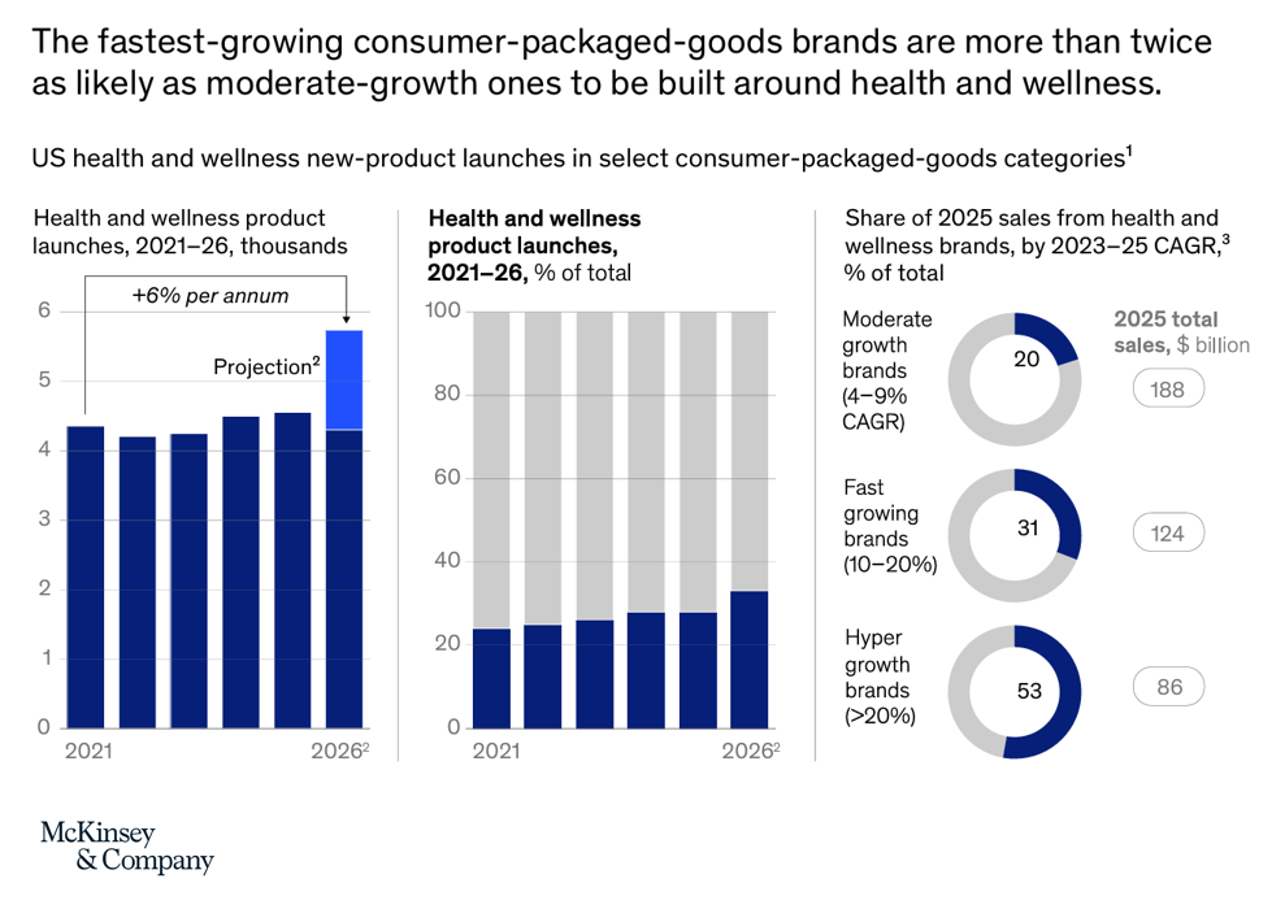
“The pursuit of wellness is changing what everyday life looks like….A few years ago, [consumers’] behaviors would have sounded fringe. Today, they describe what we call the wellness takeover: Two in three US consumers say they prioritize wellness more than they did a year ago,” McKinsey analysts (the “we” in this sentence] assert in their latest report on the Future of Wellness 2027: Inside the $2.7 trillion takeover.
That so-called “takeover” can be a win-win for both the consumers, seeking value and evidence in their health+wellness spending, and the companies and organizations providing the products and services: that’s because baking health and wellness into those offerings represent faster-growing brand opportunities in this expanding market landscape.
The first chart presents McKinsey’s data on that ROI for CPG (consumer-packaged-goods) categories: the right-hand circle charts show that the “hyper” growth brands have an over 20% compound-annual growth rate.
The top-line: over one-third of consumers say wellness is core to their identity. And while this phenomenon has been typically felt among younger people (Gen Z and Millennials), the growth among Boomers has been significant: those Boomers who said they prioritized wellness grew 11 percentage points reaching 49% in McKinsey’s 2026 consumer survey.
But you just can’t claim you offer health or wellness benefits in a product or service: the two top factors health consumers consider when spending out-of-pocket money for these items are price and effectiveness.
More than one-half of consumers McKinsey polled have tapped into AI for health and wellness support. In fact, the more consumers spent on health and wellness, McKinsey found the more likely those consumers were to use AI for the search.
Using AI didn’t necessarily “pull consumers away from doctors,” McKinsey notes. “Clinical credibility still carries real weight with consumers,” the report asserts. And that speaks to the sort of science-backed formulations and expert clinical validation that drive consumers desire to have information on effectiveness and evidence, noted in the previous chart.
I distilled the bar chart on use of AI for wellness across use cases here from the McKinsey report for mental wellness and sleep, nutrition and diet, medical guidance, fitness, and beauty/appearance.
Health Populi’s Hot Points: Coinciding with the publication of McKinsey’s wellness forecast, you can also get complementary insights from The Global Wellness Economy Monitor 2026 report from the Global Wellness Institute published in November.
The GWI report adds additional details on the wellness marketplace with some broader and more granular definitions and segments, shown in the multicolor chart of the sectors – from “explosively” growing (like real estate and mental health) to mature sectors, tourism, and public health and workplace markets.
The quote above summarizes GWI’s view on this industry: that the wellness economy is a force in the macro-global economy, larger than other microeconomies.
I concur with this enlarged landscape definition on wellness and health and medicine, which are blurring in the eyes — and wallets — of consumers.
The last graphic shown here comes out of my book, HealthConsuming, which was published in 2019 as my analysis and forecast on how health/care was creating both “health consumers” as well as “consuming” peoples’ dollars and patience with the traditional healthcare (or “sickcare”) system. My artist-collaborator pictured a community with health everywhere — in retail settings, gyms, pharmacies, schools, parks and rec, hospitality (including medical and general tourism), in banks and financial institutions, and to be sure, at home.
This was envisioned in the year before the COVID-19 pandemic changed us and our views on personal health, family health, community health, and public health broadly defined.
We are all, increasingly, morphing into wellness consumers, prioritizing our health and well-being. This was once the purview of the wealthy and the youngest among us.
This is fast-changing, becoming democratized, from the highest-end Equinox gym and wellness spa in Thailand, to your local Walmart and favorite grocery store.
The post The Business Case for Baking Health and Wellness Into Products – Listening to McKinsey and GWI appeared first on HealthPopuli.com.