
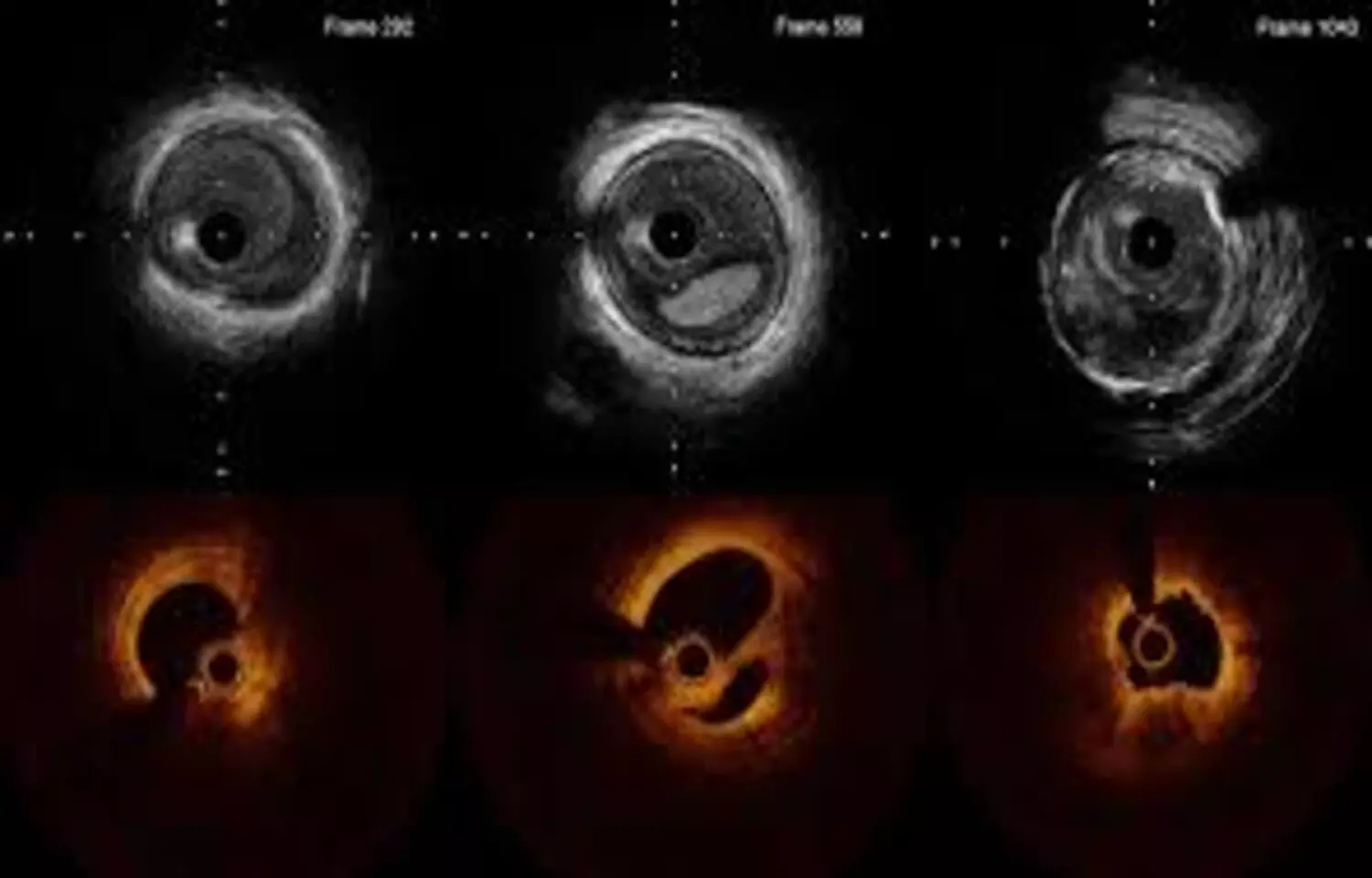
Five-year follow-up data from the RENOVATE-COMPLEX-PCI trial show that intravascular imaging–guided percutaneous coronary intervention leads to better clinical outcomes in patients with complex coronary lesions. Earlier results (median follow-up 2.1 years) demonstrated a 36% relative reduction in target-vessel failure—including cardiac death, target-vessel myocardial infarction, or clinically driven target-lesion revascularization—compared with angiography-guided percutaneous coronary intervention. In addition, target-vessel MI or cardiac death decreased by 37%, and cardiac death alone by 53%, highlighting the long-term benefit of intravascular imaging guidance.Data regarding long-term outcomes of intravascular imaging-guided percutaneous coronary intervention (PCI) for complex coronary artery lesions, compared with angiography-guided percutaneous coronary intervention, remain limited.The authors sought to present long-term clinical outcomes of intravascular imaging-guided percutaneous coronary intervention compared with angiography-guided percutaneous coronary intervention in patients with complex coronary artery lesions. Eligible patients with complex coronary artery lesions were randomly assigned 2:1 to undergo intravascular imaging-guided percutaneous coronary intervention or angiography-guided percutaneous coronary intervention in this prospective multicenter open-label superiority trial performed in South Korea. The primary endpoint was a composite of cardiac death, target vessel-related myocardial infarction, or clinically driven target vessel revascularization.Results: A total of 1,639 patients underwent randomization with 1,092 assigned to imaging-guided percutaneous coronary intervention and 547 assigned to angiography-guided percutaneous coronary intervention. At a median follow-up of 5.3 years (Q1-Q3: 4.4-6.2 years), the primary endpoint occurred in 109 of 1,092 patients (10.5%) in the intravascular imaging-guided percutaneous coronary intervention group and 78 of 547 patients (14.9%) in the angiography-guided percutaneous coronary interventiongroup (HR: 0.68; 95% CI: 0.51-0.91; P = 0.009). Cardiac death or target vessel–related myocardial infarction occurred in 78 patients (7.6%) in the intravascular imaging-guided percutaneous coronary intervention group and in 56 patients (10.7%) in the angiography-guided percutaneous coronary intervention group, clinically driven target vessel revascularization in 45 (4.4%) and 32 (6.2%), and definite stent thrombosis in 1 (0.1%) and 4 (0.7%), respectively. There were no apparent differences in procedure-related safety events between the groups.In patients with complex coronary artery lesions undergoing percutaneous coronary intervention, intravascular imaging guidance reduced the risk of a composite of cardiac death, target vessel–related myocardial infarction, or clinically driven target vessel revascularization at median follow-up of 5.3 years, compared to angiography guidance. Reference:Lee, J, Kim, O, Song, Y. et al. Intravascular Imaging- vs Angiography-Guided Complex PCI: 5-Year Outcomes From a Randomized Trial. JACC. null2026, 0 (0) .https://doi.org/10.1016/j.jacc.2026.01.035Keywords:Intravascular, Imaging, Improve, Long-Term, Outcomes, Complex PCI, Study, Lee, J, Kim, O, Song, Y.