
Nearly Half of Working-Age Adults Had Difficulties Affording Health care in 2025 is the title of new research jointly authored by the Urban Institute and the Robert Wood Johnson Foundation.
The researchers conducted the Well-Being and Basic Needs Survey in December 2025, capturing U.S. adults’ experiences with health care affordability among people ages 18 to 64.
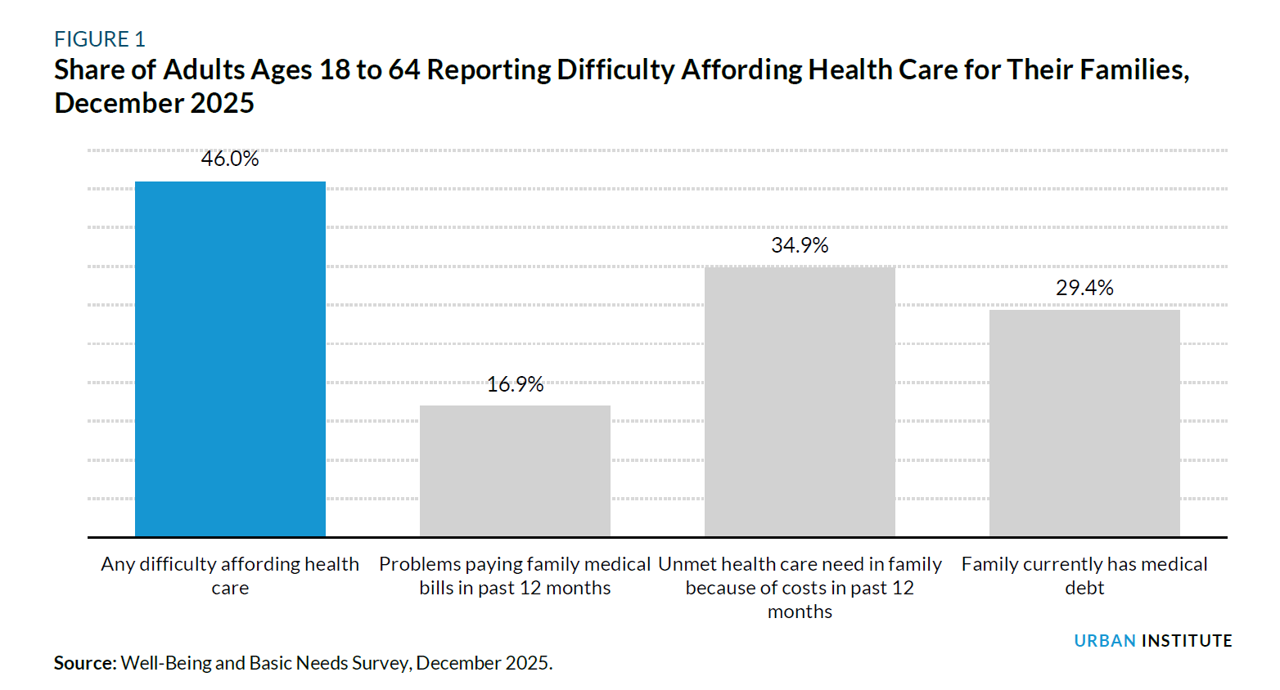
The first bar graph shows that 46% of working-aged people in the U.S. had any difficulty affording healthcare, including 35% who had unmet health care needs in the family due to costs in the past 12 months; 29% whose family currently held medical debt; and, 17% who had problems paying medical bills in the past year.
The extent of affordability varied based on the type of health plan in which the health citizen was enrolled: 57% of people enrolled in Medicaid had difficulties affording healthcare overall, compared with 54% of folks holding individual market coverage and 29% of people enrolled in employer coverage.
By age and ethnicity, Black non-Hispanic adults had the most difficult affording healthcare (57%), closely followed by 56% Hispanic adults and people of other races (not White or Asian), and then 41.6% of White non-Hispanic adults and 28% of Asian non-Hispanic adults.
It follows that people in less good health would have more challenges paying for health care, which this bar chart clearly illustrates: two-thirds of adults in fair or poor health had difficulty paying for health care, compared with 42% of adults in excellent, very good, or good health status.
Those with disabilities follow this pattern as well.
Check out variations of affordability challenges based on a working-age person’s chronic condition: note the majority of working-age people dealing with stroke, COPD, cancer, heart disease, diabetes, arthritis, and asthma are subject to greater risk for healthcare unaffordability.
Health Populi’s Hot Points: Not only are working-age Americans challenged with paying for health care costs, but so too are retirees. We might assume that Medicare was meant to cover all costs of health care among older Americans, but not so — there are premium payments, payments for filling in gaps for care services, premiums for Medicare Part D drug plans, and other costs not covered by the plan.
I learned a lot from a recent study by Schroders, the financial firm, who conducted a 2026 Retirement Survey from which the quote here comes. As Deb Boyden, the firm’s Head of U.S. Defined Contribution, observed, “Retirees are fighting the affordability crisis with a fixed pool of assets and no second chances.”
The latest forecast out this week from the Centers for Medicare and Medicaid Services forecasted that the Medicare Trust Fund will be insolvent by 2033 – just a few years from “now.”
So consider the volume of older Americans entering their retirement phase this and the coming years, combined with the chart illustrating that the more chronic conditions and disabilities a person has to deal with, the less likely they can cover their healthcare costs. The current inflationary environment is already challenging for older healthcare consumers as found in the Schroder retirees’ study for 2026.
We’ll need to address the costs of aging at home leveraging technology with humans in the loop, along with promoting greater self-care and retail health, community-based solutions, to address this challenge. Doing so will also benefit working-age health citizens who are already adopting wearable technology, food-as-medicine, and AI-front doors for health care information and support.
The post Even with Health Insurance, Half of Working-Age People in the U.S. Can’t Afford Healthcare (and a PS on Retiree Health Costs) appeared first on HealthPopuli.com.