
What You Should Know
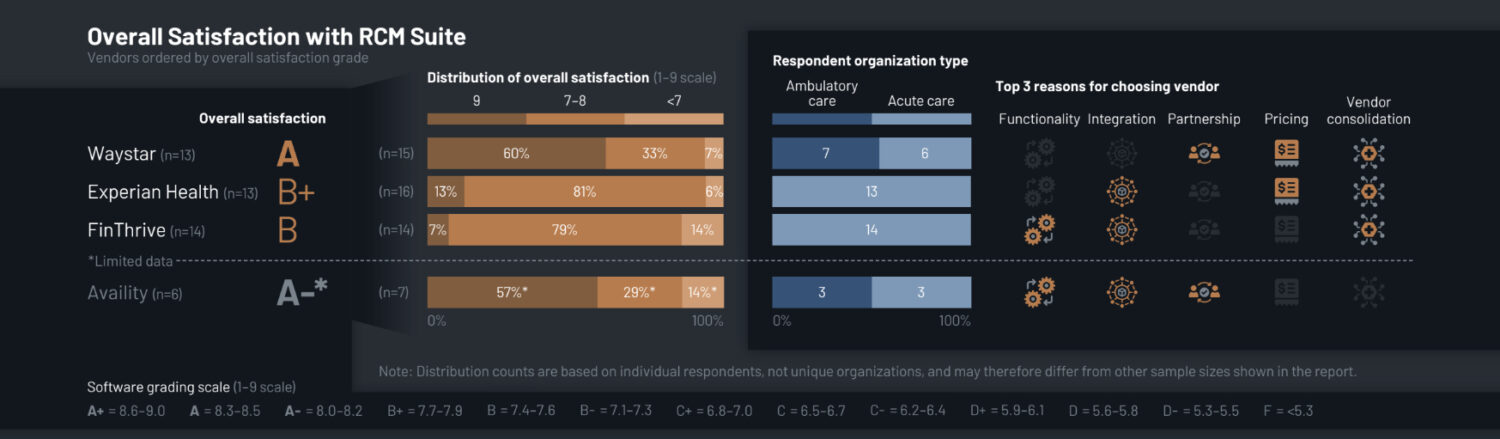
The 2026 KLAS Revenue Cycle Management Suites Report focuses on healthcare organizations using at least three distinct RCM modules (e.g., claims, eligibility, denials, insurance discovery) from a single vendor.KLAS highlights that while consolidation is accelerating, it has yet to validate a single vendor offering a fully mature, end-to-end RCM platform without functional trade-offs.Waystar earned an overall “A” grade—the highest in the report—driven by strong strategic partnership, cohesive UI across acquired modules, price bundling that reduces “nickel-and-diming,” and high adoption of AI-generated appeals.The top primary drivers for health systems going “all in” with a single RCM vendor are vendor consolidation (57%) and building a stronger strategic partnership (57%), followed by pricing (43%) and expanded functionality (41%).“Deep adopters” report the most consistent improvements in workflow efficiency, cash collections, and total time to collect, though vendor cost reductions remain rare due to module add-on pricing.
Beyond Point-Solution Fragmentation
The revenue cycle management (RCM) technology, hospital financial operations, and claims clearinghouse markets are undergoing an urgent consolidation phase. Over the past decade, healthcare finance executives built complex tech stacks by patching together disparate point solutions—pairing one vendor for eligibility, another for insurance discovery, a third for claims editing, and a fourth for patient statements.
However, this fragmented approach has reached an operational ceiling. Multiple vendor logins, inconsistent data feeds, disparate EHR integrations, and compounding maintenance fees have introduced massive administrative drag.
In response, major health systems are actively seeking to consolidate vendor footprints by moving toward unified RCM suites. Yet, because many of these suites were assembled rapidly through corporate acquisitions, healthcare organizations face varying levels of product integration, software maturity, and vendor support.
To help healthcare CFOs, RCM Vice Presidents, and Revenue Integrity leaders evaluate whether there is genuine financial ROI in going “all-in” with a single vendor, KLAS Research has published its 2026 report: Revenue Cycle Management Suites 2026: Partnership Is Key in Making the Suite Experience a Success.
Evaluating Market Performance: How RCM Suites Rank
The report evaluates how “deep adopters”—healthcare organizations utilizing three or more distinct RCM modules from a single vendor—experience vendor performance across key operational metrics:
Waystar (Grade: A)
Waystar emerged as the top-rated suite vendor in the report. Deep adopters point to Waystar’s strong partnership-oriented approach, dedicated account management, and proactive workflow customization as major differentiators.
Waystar’s price-bundling model effectively reduces the feeling of being “nickeled-and-dimed,” allowing health systems the financial predictability required to roll out additional modules. Furthermore, Waystar saw high adoption and satisfaction in denials management (driven by AI-generated appeal letters) and claims processing (8.7 rating).
Availity (Grade: A-*)
While evaluated on a smaller sample size, Availity deep adopters reported highly consistent operational outcomes, particularly in remittance posting (8.8 rating), clinical authorizations (8.5 rating), and eligibility (8.4 rating).
Clients view Availity as a true partner that proactively mediates with commercial payers to clear claim roadblocks and communicate during industry disruptions.
Experian Health (Grade: B+)
Experian Health demonstrates strong, trusted performance in core front-end modules like insurance discovery and eligibility (7.8 rating).
However, deep adopters report that acquired modules remain somewhat siloed, requiring multiple logins and offering lower integration maturity in areas like contract management and denials. Clients also expressed a desire for faster innovation and more transparent pricing structures when scaling to new facilities.
FinThrive (Grade: B)
FinThrive delivers robust, highly rated capabilities in contract management (7.9 rating) and insurance discovery (7.6 rating), with clients praising its ability to recover significant self-pay revenue.
However, overall satisfaction is constrained by integration challenges with underlying EHRs and long development cycles for requested software enhancements. Deep adopters frequently report working out of native EHR work queues rather than FinThrive’s web interface to maintain efficiency.
Primary Outcomes Reported by Deep Adopters
According to KLAS data, the primary motivation for consolidating RCM vendors centers on operational efficiency rather than pure software savings. The most common drivers cited by healthcare leaders include:
Ability to Consolidate Vendors (57%)Stronger Vendor Partnership/Relationship (57%)Predictable Pricing (43%)New or Expanded Functionality (41%)Enhanced Integration Between Modules (37%)
Across all measured platforms, health systems reported noticeable gains in workflow efficiency and cash collections as staff reduced time spent jumping between external payer portals. However, KLAS notes that vendor cost reduction is the least commonly achieved outcome. Even when consolidating, health systems rarely see an “all-inclusive” price tag, as adding modules or advanced analytics layers typically incurs supplemental subscription fees.