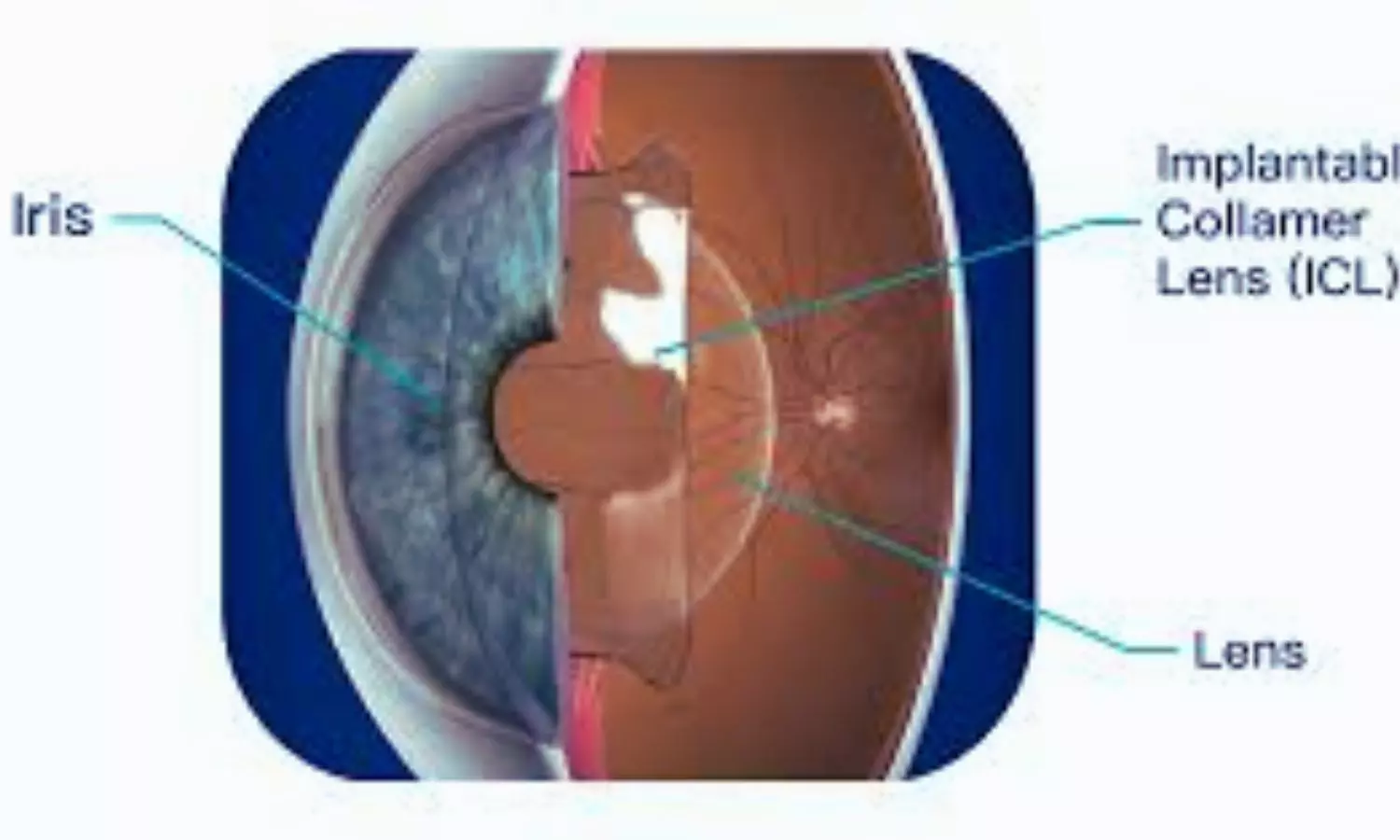
Japan: A study published in the Journal of Refractive Surgery reports that horizontal fixation of implantable collamer lenses (ICL) results in a larger postoperative vault, whereas vertical fixation may offer safer and more predictable outcomes. Using vertical fixation for ICL placement could therefore improve overall clinical results.Implantable collamer lenses are widely used for the correction of moderate to high myopia, offering an effective alternative for patients who are not suitable candidates for corneal refractive surgery. One of the most critical factors influencing the safety and success of ICL implantation is the postoperative vault, defined as the distance between the back surface of the ICL and the anterior surface of the crystalline lens. Both excessively high and low vaults are associated with complications such as cataract formation, elevated intraocular pressure, or angle closure. Accurate sizing and appropriate fixation of the lens are therefore essential.In the large retrospective study, Shuntaro Tsunehiro from the Eye Center at Sanno Hospital, Tokyo, and colleagues examined whether the direction of ICL fixation influences postoperative vault and the accuracy of vault prediction when lens size is determined using the KS formula. The analysis included 2,343 eyes from 1,275 patients who underwent myopic ICL implantation. Preoperative anterior segment optical coherence tomography was performed in both horizontal and vertical orientations, allowing precise biometric assessment before surgery.ICL sizing was calculated using the KS formula embedded in the imaging system, and postoperative vault outcomes were compared between eyes receiving horizontal fixation and those with vertical fixation. The study led to the following notable findings:A statistically significant difference was observed between fixation approaches, with the horizontal fixation group showing a higher mean postoperative vault than the vertical fixation group.The proportion of eyes with extremely high vaults (≥1 mm) was higher in the horizontal fixation group compared with the vertical fixation group.Although such cases were relatively few, the difference was statistically significant, indicating a potential safety concern with horizontal fixation.Excessively high postoperative vaults were noted as clinically important due to their association with increased risk of complications and the need for closer follow-up or intervention.Horizontal fixation was linked to greater prediction error when comparing actual postoperative vaults with values predicted using the KS formula.The median absolute error was also higher in the horizontal fixation group than in the vertical fixation group.Overall, fixation direction significantly influenced postoperative vault outcomes and the accuracy of preoperative vault prediction, even when the same sizing formula was applied.The authors conclude that vertical fixation of the ICL offers superior predictability and a lower risk of excessively high vaults when sizing is based on the KS formula. From a clinical standpoint, these results support vertical fixation as a safer and more consistent approach, particularly in efforts to minimize postoperative complications and optimize refractive outcomes.Overall, this study provides valuable evidence that fixation direction should be carefully considered during ICL implantation. Incorporating vertical fixation into routine practice may help improve surgical precision and long-term safety for patients undergoing myopic ICL correction.Reference: https://doi.org/10.3928/1081597X-20250624-06
