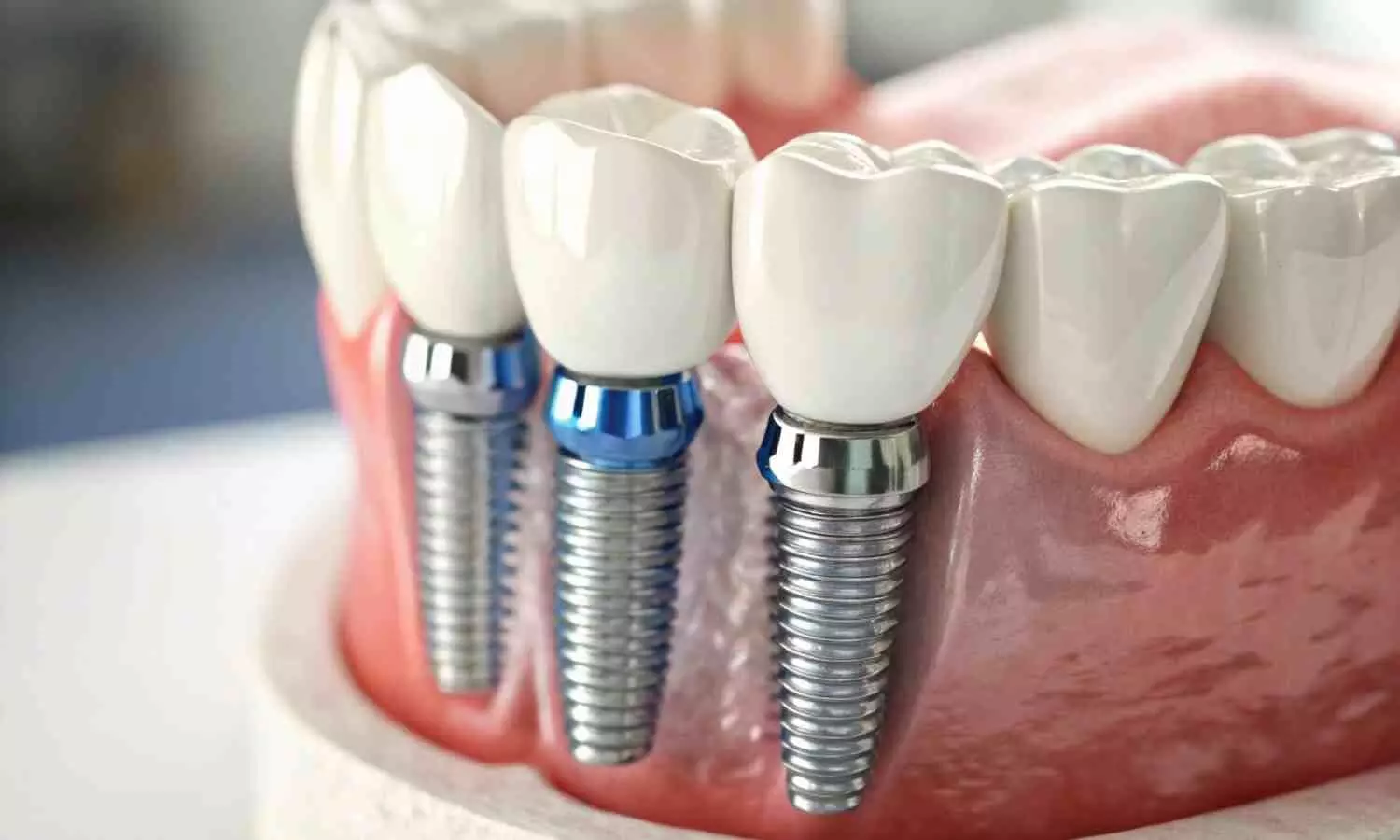
A new study published in the journal of Stomatologija showed that the fracture resistance of narrow-diameter titanium dental implants was not much reduced by implantoplasty.
To handle restricted alveolar bone width and prevent lengthy grafting operations, narrow diameter titanium dental implants are becoming more and more common in clinical practice. But under functional loads, their decreased cross-section raises questions about mechanical strength. Implantoplasty progressively decreases implant wall thickness and may jeopardize structural integrity. Therefore, fracture resistance during implantoplasty is crucial, particularly for implants with narrow diameters that are exposed to strong occlusal stresses. Making educated clinical decisions requires an understanding of how implantoplasty impacts the mechanical behavior and fracture risk of these implants. To standardize the research environment, this study compared the fracture resistance of small diameter titanium dental implants following implantoplasty using a computer numerical control (CNC) lathe machine.12 grade IV titanium endosteal screw-shaped bone-level dental implants with an internal connection and a small diameter of 3.6 x 11.0 mm were randomly split into 2 groups of six implants each. A CNC lathe-turning equipment was used to perform implantoplasty on the test group. The coronal diameter was reduced by 0.2 mm as a consequence of implantoplasty, which involved removing 5.5 mm of implant threads from the implant coronal section downward towards the apical part. 3D printed guides were used to place implants from both groups on metal pipes. Epoxy resin was poured into the pipe’s inside. Each sample has a chrome-cobalt (Cr-Co) alloy crown that was uniquely 3D printed to disperse forces throughout the test. A universal testing equipment was used to compress the implants. The successful completion of implantoplasty using a CNC lathe-turning machine contributed to the standardization of research environments. The test group’s average resistance to a maximum compressive force was 409.42 N, whereas the control group’s average resistance was 443.76 N.Regarding the compressive force component, there was no statistically significant difference between the groups. Overall, this in-vitro study demonstrates that implantoplasty does not significantly reduce the fracture resistance of titanium dental implants with a small diameter.Source:Mickevičius, O., & Pauliukevičius, A. (2025). Narrow diameter titanium dental implants fracture resistance after implantoplasty. Stomatologija, 27(1), 3–8. https://sbdmj.lsmuni.lt/251/251-01.pdf
Implantoplasty fails to Reduce Fracture Resistance of Narrow Titanium Implants: Study
 By
health_news
By
health_news