
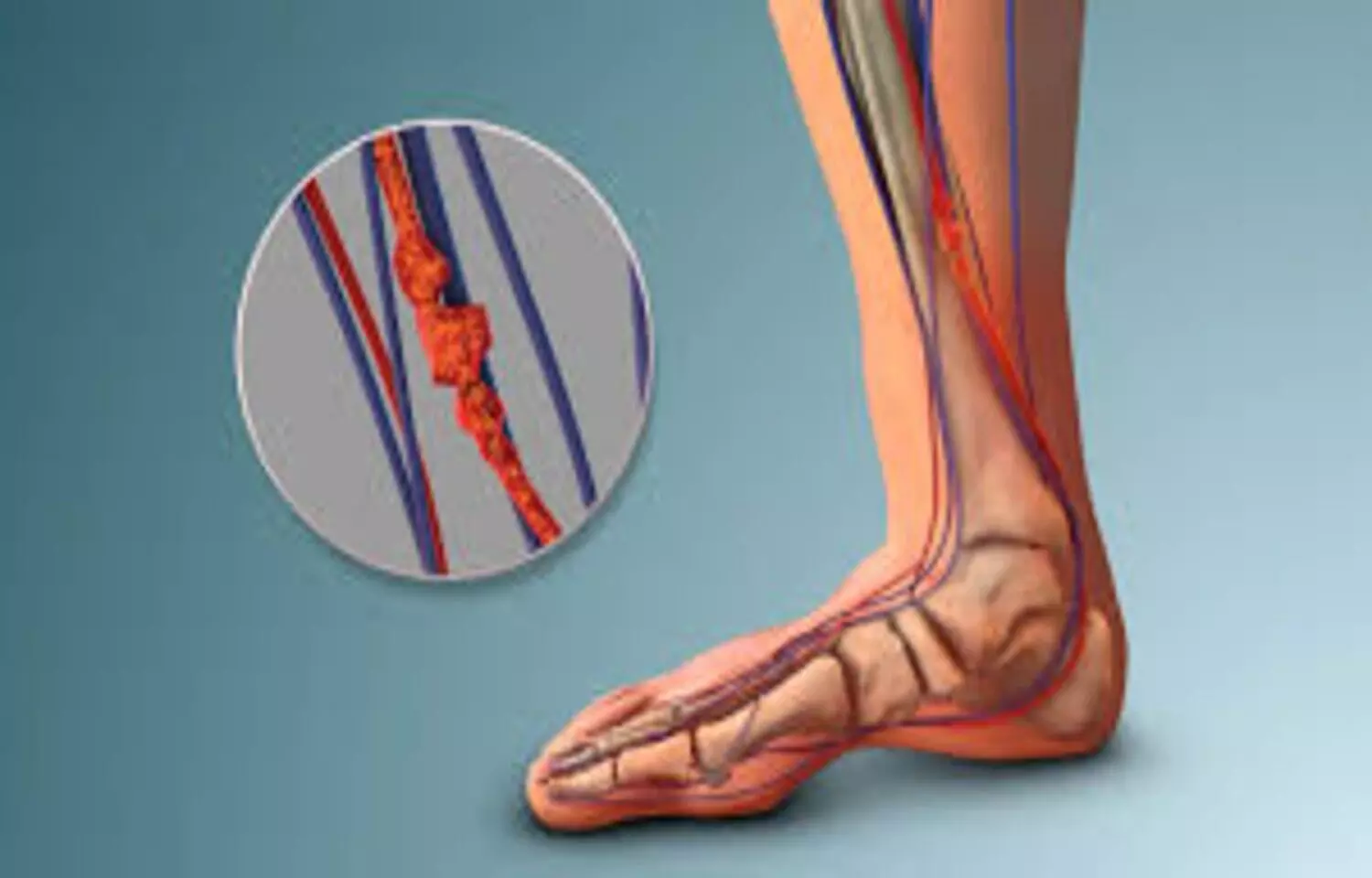
Researchers have found in a new study that using an age-adjusted D-dimer cutoff can safely rule out deep vein thrombosis and allows a greater number of patients to be effectively excluded from having deep vein thrombosis.The age-adjusted D-dimer cutoff (age × 10 µg/L in patients 50 years or older), safely increases the diagnostic yield of D-dimer in patients with suspected pulmonary embolism but has not been validated in patients with suspected leg deep vein thrombosis (DVT). A study was done to prospectively validate whether using an age-adjusted D-dimer cutoff allows clinicians to safely rule out eep vein thrombosis. Patients were assessed by a sequential diagnostic strategy based on the assessment of clinical pretest probability by the Wells score, a highly sensitive D-dimer test, and leg compression ultrasonography. Patients in whom eep vein thrombosis was ruled out were followed up for a 3-month period.The primary outcome was the rate of adjudicated symptomatic venous thromboembolic events during follow-up in patients in whom eep vein thrombosis was ruled out based on a D-dimer value between the conventional cutoff of 500 µg/L and their age-adjusted cutoff. Results A total of 3205 patients were included. Median age was 59 years, and 1737 (54%) were female. Deep vein thrombosisprevalence was 14%. Among the 2169 patients with a non-high or unlikely clinical probability, 531 (24.5% [95% CI, 22.7%-26.4%]) had a D-dimer level less than 500 µg/L, and 161 additional patients (7.4% [95% CI, 6.4%-8.6%]) had a D-dimer level between 500 µg/L and their age-adjusted cutoff. No failures were identified in patients with a D-dimer level 500 µg/L or greater but below the age-adjusted cutoff (0% [95% CI, 0%-2.3%]). Among patients 75 years or older, using the age-adjusted cutoff instead of the 500-µg/L cutoff increased the proportion of negative D-dimer from 33 of 379 (8.7% [95% CI, 6.3%-12.0%]) to 99 of 379 (26.1% [95% CI, 22.0%-30.8%]), without any false-negative test results.The age-adjusted D-dimer cutoff may safely rule out deep vein thrombosis and was associated with a larger number of patients in whom eep vein thrombosis could be effectively ruled out.Reference:Le Gal G, Robert-Ebadi H, Thiruganasambandamoorthy V, et al. Age-Adjusted D-Dimer Cutoff Levels to Rule Out Deep Vein Thrombosis. JAMA. 2026;335(5):416–424. doi:10.1001/jama.2025.21561Keywords:Age-Adjusted, D-Dimer, Cutoff, may, Safely, Rule-Out DVT, JAMA, Le Gal G, Robert-Ebadi H, Thiruganasambandamoorthy V, JAMA