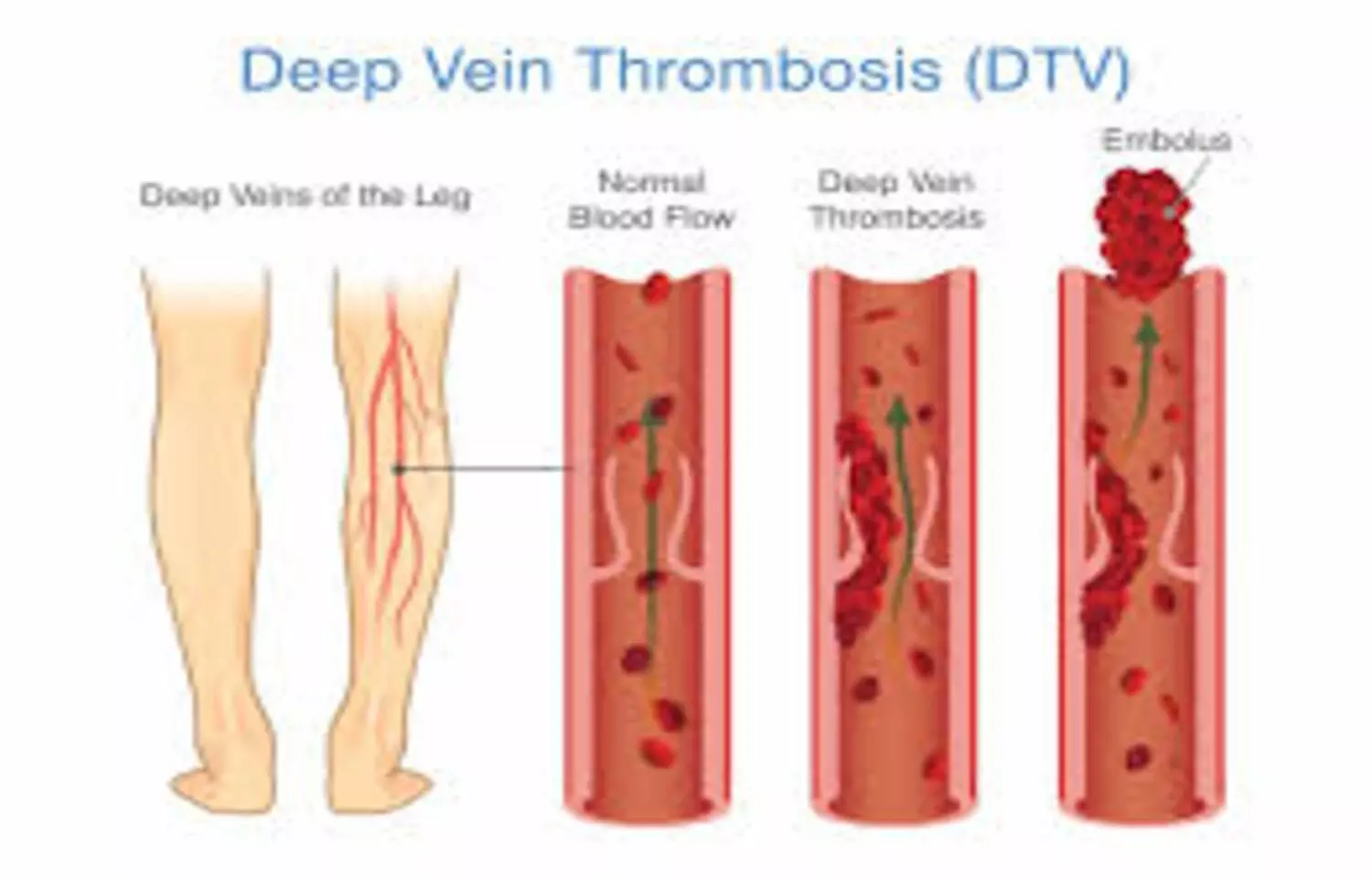
Researchers have found in a new study that injuries sustained at high elevations are linked to significantly higher odds of developing deep vein thrombosis compared with injuries at low elevations. The increased risk is thought to be related to physiological effects of high altitude, including reduced oxygen partial pressure and hemoconcentration, which may promote thrombogenesis in trauma patients.Prior research explored the effect of elevation on deep vein thrombosis (DVT) but primarily examined injuries at elevations <1000 or >4000 feet, excluding elevations in between, and focused on specific subsets of trauma patients. This study aimed to conduct a more detailed analysis of the relationship between elevation and deep vein thrombosis in all trauma admissions. This retrospective cohort study at four level I trauma centers included adult trauma patients (October 1, 2022 to October 1, 2023). Injury zip codes were used to define elevation. High-elevation (H-ELV) injuries (≥5000 feet) were compared with low-elevation (L-ELV) injuries (<5000 feet). Elevation was further categorized into 1000-foot increments. An alpha of <0.0001 defined statistical significance.Results Of 8620 patients, 49% (4231) had L-ELV injuries and 51% (4389) had H-ELV injuries. Compared to patients with L-ELV injuries, those with H-ELV injuries were significantly older, had lower oxygen saturation and higher heart rate, suffered falls and sports injuries more often, and motor vehicle collisions less often, and had a higher rate of comorbidities, including alcohol use disorder and anticoagulant use. DVTs occurred significantly more often after H-ELV injuries than L-ELV injuries (1.9% vs. 0.5%, p<0.0001). For each 1000-foot increase in elevation, there was a corresponding 0.4% average increase in the rate of deep vein thrombosis (moderate R2=0.6). After adjustment for alcohol use disorder and oxygen saturation, H-ELV injuries were associated with a 3.8-fold increase (95% CI 2.3 to 6.4) in the risk of deep vein thrombosis when compared with L-ELV injuries.Even after adjustment, H-ELV injuries were associated with 3.8 increased odds of developing a deep vein thrombosis compared with L-ELV injuries. There was a significant positive linear association between deep vein thrombosis and injury elevation, with the rate of deep vein thrombosis increasing with increasing elevation. This finding may suggest the need for enhanced screening or tailored deep vein thrombosis prophylaxis methods at higher elevation trauma centers to improve outcomes.Reference:Banton KL, Jarvis S, Jungels CG, Acuna D, Palacio CH, Hovorka J, et al. Effect of high elevation on deep vein thrombosis: a multicenter cohort study. Trauma Surgery & Acute Care Open. 2026;11:e002001. https://doi.org/10.1136/tsaco-2025-002001Keywords:High-Altitude, Trauma, Associated, Increased, Risk, Deep Vein Thrombosis, Study, Banton KL, Jarvis S, Jungels CG, Acuna D, Palacio CH, Hovorka J,
