
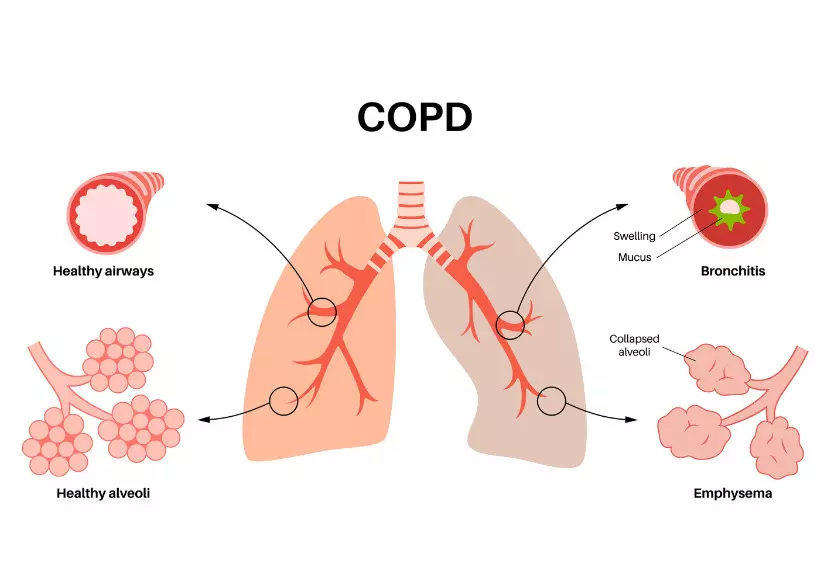
Researchers have found in a new study that the hemoglobin, albumin, lymphocyte, and platelet score serves as an independent predictor of 30-day readmission in patients with acute exacerbation of chronic obstructive pulmonary disease. A reduction in the hemoglobin, albumin, lymphocyte, and platelet score correlates with greater disease severity and independently predicts short-term rehospitalization risk, highlighting its value as a practical biomarker for identifying high-risk patients.Chronic obstructive pulmonary disease is a leading cause of morbidity and mortality worldwide, with acute exacerbations significantly contributing to disease burden and healthcare costs. This study aimed to explore the predictive role of the hemoglobin, albumin, lymphocyte, and platelet score in 30-day readmission risk in patients with acute exacerbation of chronic obstructive pulmonary disease. Patients were categorized into rehospitalization and non-rehospitalization groups based on 30-day chronic obstructive pulmonary disease-related readmission. The hemoglobin, albumin, lymphocyte, and platelet score on the day of intensive care unit admission, during the acute phase, was calculated as (hemoglobin × albumin × lymphocyte count) divided by platelet count. Spearman correlation analysis was performed to evaluate associations of acute-phase hemoglobin, albumin, lymphocyte, and platelet scores with acute-phase Acute Physiology and Chronic Health Evaluation IV scores and stable-phase forced expiratory volume in one second to forced vital capacity ratio. Receiver operating characteristic curves were plotted to compare the hemoglobin, albumin, lymphocyte, and platelet score and C-reactive protein in predicting 30-day readmission. Cox regression was conducted to identify independent risk factors for readmission. The rehospitalization group exhibited significantly lower hemoglobin, albumin, lymphocyte, and platelet scores. Acute-phase hemoglobin, albumin, lymphocyte, and platelet scores were negatively correlated with acute-phase Acute Physiology and Chronic Health Evaluation IV scores and positively correlated with stable-phase forced expiratory volume in one second to forced vital capacity ratio. Hemoglobin, albumin, lymphocyte, and platelet scores declined progressively with higher Global Initiative for Chronic Obstructive Lung Disease grades. Hemoglobin, albumin, lymphocyte, and platelet scores demonstrated superior predictive accuracy for 30-day readmission compared to C-reactive protein.Multivariate analysis confirmed the hemoglobin, albumin, lymphocyte, and platelet score as an independent predictor of 30-day readmission. Overall, reduction in the hemoglobin, albumin, lymphocyte, and platelet score correlates with acute exacerbation severity in chronic obstructive pulmonary disease and independently predicts 30-day readmission, serving as a valuable biomarker for short-term rehospitalization risk.Reference:Zheng, Bingzhen, and Ru Li. Hemoglobin, Albumin, Lymphocyte, and Platelet Score Predicts 30-day Readmission Risk in Patients With Acute Exacerbation of Chronic Obstructive Pulmonary Disease: A Single-center Retrospective Study. Scandinavian Journal of Clinical and Laboratory Investigation, 2026, pp. 1–10.Keywords:Hemoglobin, Albumin, Lymphocyte, and Platelet Score, Predicts, 30-Day, Readmission, Acute Exacerbation, Chronic Obstructive Pulmonary Disease, Study