
With many diabetes mellitus (DM) patients struggling with the
challenges of multiple daily insulin injections, there is a growing need for
convenient and needle-free insulin delivery options. Addressing this gap, Cipla
Ltd., one of India’s leading pharmaceutical companies, has recently launched a
novel Technosphere® Insulin (TSI), the world’s only available inhaled insulin,
under the brand name Afrezza® 1-4.
Afrezza® contains Technosphere® Insulin (TSI); is a dry
powder formulation of regular human insulin adsorbed onto Technosphere®
microparticles for oral inhalation. These microparticles are composed of key
component fumaryl diketopiperazine (FDKP), with insulin bound to their surface.
The TSI powder is administered through a breath-powered inhaler that ensures
consistent and reproducible insulin delivery. Upon inhalation, the particles
reach the lung alveoli, where the physiological pH (pH > 6) causes them to
dissolve rapidly, allowing both insulin and FDKP to be quickly absorbed into
systemic circulation 5.
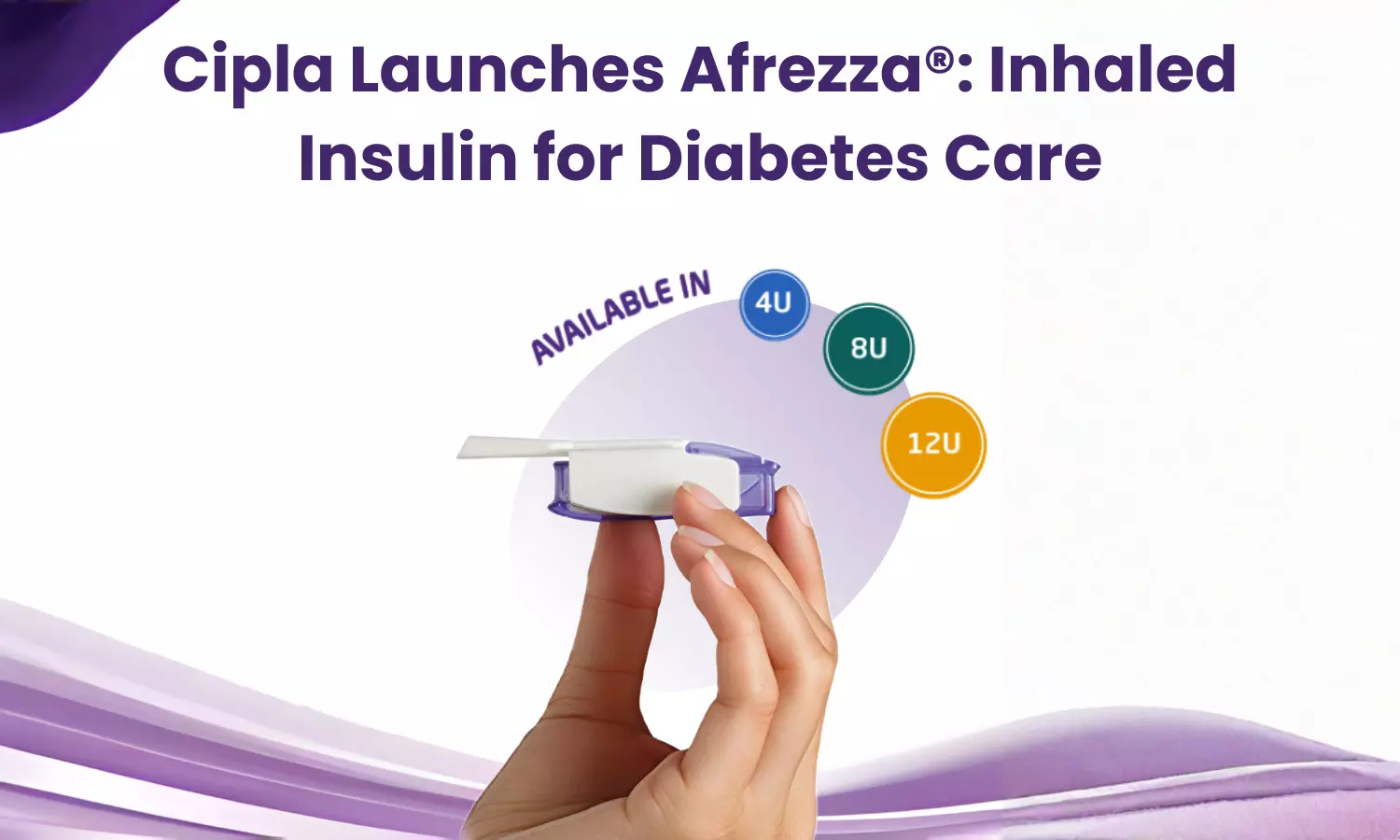
Afrezza®,
available in 4U, 8U, and 12U cartridge strengths for flexible dosing based on
individual insulin requirements, and indicated to improve glycemic control in
adult patients with diabetes mellitus. Afrezza® is prandial insulin
and to be taken at the beginning of meal. It is
contraindicated in patients with chronic lung disease and not recommended in
active smokers, or who left smoking in recent 6 months. The Forced Expiratory Volume in 1 second (FEV1) assessment at the
initiation of Afrezza® therapy and its regular monitoring is
recommended 6.
Afrezza® has a rapid onset of action (~ 12 minutes),
peak effect at ~45 minutes, with duration of ~180 minutes, offering “fast in,
fast out” benefits and close resemblance to natural insulin 7.
Pivotal clinical
trials have demonstrated the efficacy and safety of TSI in managing diabetes
mellitus (DM) in adults. The landmark trials and key insights include:
Affinity 1: Technosphere® Insulin (TSI) Demonstrated Noninferiority
to Insulin Aspart in Type 1 Diabetes
Mellitus (T1DM) Patients 8
In a 24-week randomized non-inferiority trial
comparing the efficacy and safety of TSI with insulin aspart in patients with
T1DM and receiving basal insulin. TSI reduced HbA1c by 0.21% from a baseline of
7.94%, demonstrating non‑inferiority to insulin aspart, which reduced HbA1c by
0.40% from a baseline of 7.92%. The between‑group difference (0.19%; 95% CI:
0.02, 0.36) was within the predefined non‑inferiority margin of 0.4%. Additionally,
TSI-treated patients experienced a lower rate of hypoglycaemia compared to
those receiving insulin aspart [9.8 vs. 14.0 events/patient/month]. These
findings highlight similar efficacy between TSI and insulin aspart, with the
added advantage of a lower hypoglycemia event rate.
Affinity 2: Technosphere® Insulin (TSI) Provides significant HbA1c
reduction in Type 2 Diabetes Mellitus (T2DM) patients 9
A 24-week, randomized, double-blind,
placebo-controlled trial comparing the efficacy and safety of TSI Vs.
Technosphere® placebo (TP) in insulin-naïve T2DM patients uncontrolled on oral
antidiabetic drugs (OADs). TSI provided significantly higher HbA1c reduction Vs
TP at 24 week (-0.8% vs -0.4%) with difference in HbA1c as -0.4%; 95% CI
(-0.57, -0.23); P<0.0001. The TSI group demonstrated sustained post prandial
glucose (PPG) reductions, resulting in a flatter and more stable prandial
profile compared to TP. The incidence of all and severe hypoglycemia were
higher in the TSI group than in the TP group [all hypoglycemia
events/patient/month 1.16 vs 0.5, p value:<0.001; severe hypoglycemia
events/100 patients/month 2.37 vs. 0.6,
p value: 0.2024]. Mild, transient dry
cough was the most common adverse event, reported in 23.7% (TSI) vs. 19.9%
(TP).
Technosphere® Insulin (TSI)
Demonstrated Significant HbA1c reduction in T2DM patients in Indian phase III
study 10.
A 24-week, phase 3, randomized, double-blind,
placebo-controlled, parallel-group study was designed to evaluate the efficacy
and safety of TSI in Indian adults with T2DM inadequately controlled on oral
antihyperglycemic drugs (OADs). A total of 216 patients (HbA1c 7.5-10.5%) were
enrolled (TSI: n=133; Placebo: n=83). At week 12, TSI significantly reduced
HbA1c Vs. Technosphere® placebo (TP) (-0.620% vs. -0.203%; mean difference
-0.417%, 95% CI: -0.74, -0.09; P=0.0124). Hypoglycemia was reported as one of
the most common adverse event [25.6% (TSI) vs. 16.9 % (TP)], with similar cough
incidences in two groups [9% (TSI) vs. 8.4% (TP)]. The study also showed that
TSI had no significant effect on lung function.
Now, ADA 2026 guidelines also
recommended the use of inhaled insulin for prandial or
correction doses in diabetes mellitus patients
due to its faster onset and shorter duration than rapid-acting insulin analogues 11.
Reference: 1. https://investors.mannkindcor
p.com/news-releases/news release-details/mannkind corporation-announces-fda
approval-afrezzar-novel-rapid; as accessed on February 2nd, 20262. https://investors.mannkindcor
p.com/news-releases/news release-details/sanofi-and mannkind-announce-afrezzar
only-inhaled-insulin-now; as accessed on February 2nd, 20263. https://www.cipla.com/press
releases-statements/cipla launches-indias-only-inhaled insulin-afrezzar; as
accessed on February 2nd, 20264. https://www.accessdata.fda.g
ov/drugsatfda_docs/label/202 6/022472s027lbl.pdf; as accessed on February 2nd,
20265. Pfützner A, Forst T. Pulmonary insulin
delivery by means of the Technosphere drug carrier mechanism. Expert Opin Drug
Deliv. 2005;2(6):1097-106.6. Afrezza India Prescribing Information.
Available at https://www.ciplamed.com/product-index/afrezza?product-speciality=Diabetology. Accessed on 10th december 2025.7. Available from:
https://afrezzahcp.com/mimics-physiologic-insulin/. Last accessed on.09th
October 2025.8. Bode BW, McGill JB,
Lorber DL, Gross JL, Chang PC, Bregman DB, et al. Inhaled Technosphere Insulin Compared With
Injected Prandial Insulin in Type 1 Diabetes: A Randomized 24-Week Trial.
Diabetes Care. 2015;38(12):2266-73.9. Rosenstock J, Franco D,
Korpachev V, Shumel B, Ma Y, Baughman R, et al. Inhaled Technosphere Insulin Versus Inhaled
Technosphere® Placebo in Insulin-Naïve Subjects With Type 2 Diabetes
Inadequately Controlled on Oral Antidiabetes Agents. Diabetes Care.
2015;38(12):2274-81.10. Poster # 833-P, ADA 2025, June 20-23, Chicago, IL.11. ADA Professional Practice Committee for Diabetes*.
9. Pharmacologic Approaches to Glycemic Treatment: Standards of Care in
Diabetes-2026. Diabetes Care. 2026;49(Supplement_1):S183-S215.